

Your booking confirmation is in an email you cannot open. Your ship turned your data off. Here is how phones actually behave on a Cozumel cruise excursion, and the offline setup that removes the problem entirely.
No Signal, No Wi-Fi, No Problem: Staying Reachable on a Cruise Excursion in Cozumel
There is a specific moment that happens at the Cozumel piers most mornings. Someone steps off the ship, opens their phone to pull up the excursion confirmation they were told to show the guide, and finds a spinning wheel where the email should be.
Their ship's wi-fi does not reach the pier. Their cell plan has not connected to a Mexican network. The confirmation exists, technically, on a server in another country. And the guide is asking for the booking name.
This is the most common avoidable problem on a cruise excursion, and it is entirely a preparation issue. Guides at every Cozumel meeting point deal with it daily.
What follows is how phones actually behave on a Cozumel port day, and a setup that takes ten minutes the night before and makes the whole category of problem disappear.
Three Different Networks, and Why People Confuse Them
Most of the confusion here comes from treating "internet" as one thing. On a port day it is three separate systems with three separate failure modes.
1. Ship wi-fi. Satellite-based, sold as a package, and it works while you are aboard. It generally does not extend usefully down the gangway and across the pier, and it certainly does not follow you to a beach on the other side of the island. Ship wi-fi is also frequently the connection people are unknowingly relying on when they "check something" in the terminal building — the signal fades and the check silently fails.
2. Your home cell carrier, roaming in Mexico. This may work well, work expensively, or not work at all, entirely depending on your plan. Some plans include Mexico at no additional cost. Some charge a flat daily rate. Some charge steep per-megabyte international rates. Check before you sail, not after — and check specifically for Mexico, since a plan covering Canada does not necessarily cover Mexico.
3. Local Mexican networks, via an eSIM or local SIM. Cozumel has real cellular coverage from the major Mexican carriers. Modern phones support eSIMs, which can be purchased and installed before you leave home and activated on arrival — no shop visit, no swapping a physical card, no risk of losing your home SIM in a hotel room.
The trap that catches the most people is a fourth thing that looks like connectivity but is not:
Airplane mode with wi-fi on. Many cruisers put their phone in airplane mode for the whole voyage to avoid roaming charges — sensible — and then forget that this is why nothing loads ashore. The phone shows a wi-fi icon from some network it cannot actually reach, and everything appears to be almost working.
Where Coverage Actually Drops in Cozumel
Coverage on the island is not uniform, and the pattern is worth knowing because it maps directly onto where excursions go.
Reliable, generally: San Miguel and the downtown area, all three cruise piers, the developed west coast where most beach clubs and resorts sit, and the main cross-island road.
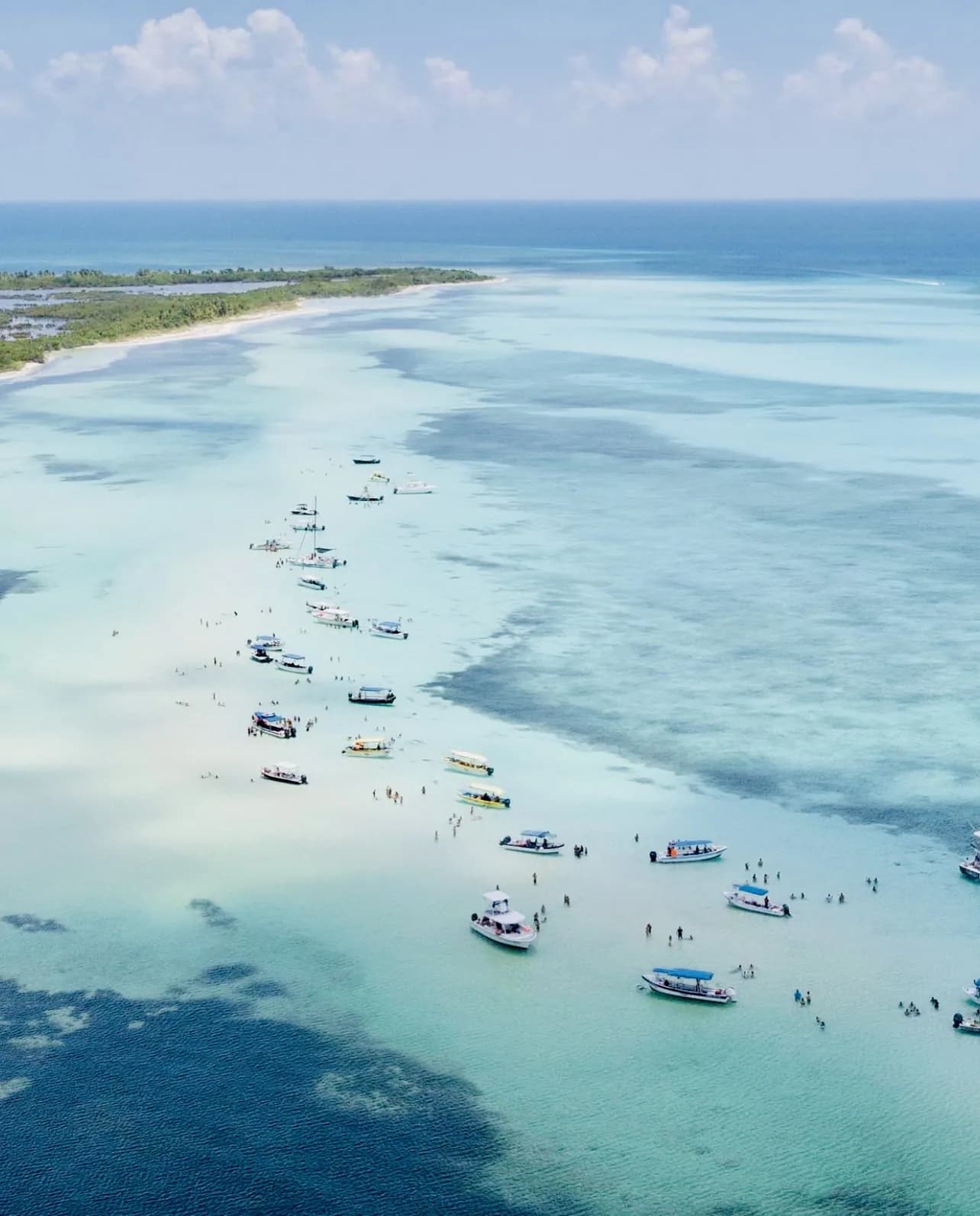
Patchy or absent: the east (windward) coast, which is largely undeveloped; the interior jungle where ATV and jeep routes run; parts of Punta Sur; and — the one that catches people out — anywhere on the water. Boat-based excursions lose signal quickly once they are offshore. Snorkel and dive trips to the southern reefs, catamaran cruises, and the crossing to Isla Pasión all spend meaningful time out of range.
Which produces a straightforward planning rule: the excursions that are most fun are disproportionately the ones with no signal. Water and jungle are exactly where the network is not.
There is also a hardware reality on water trips: a phone that is wet is a phone that is off. A dropped phone in three feet of sand and saltwater is the single most common piece of gear lost on a Cozumel port day. A cheap waterproof pouch on a lanyard solves it, and a phone sealed in a pouch is not a phone you are checking messages on anyway.
The Time Zone Problem That Looks Like a Phone Problem
This one deserves its own section because it disguises itself as a technical glitch and can cost you a ship.
Quintana Roo — the state Cozumel belongs to — observes Eastern Standard Time year-round and does not use daylight saving time.
Meanwhile, your ship keeps its own time, which may or may not match local shore time, and which the cruise line sets for the voyage.
Now add a phone. When your phone connects to a Mexican network, it may automatically update to local time. If it is in airplane mode, it may still be showing the time from wherever it last synced — possibly your home time zone, possibly ship time. So three clocks exist, they disagree, and the one that governs whether you are left behind is ship time, which is the one your phone is least likely to be showing.
The fix is boring and effective:
- Set a watch, or a second phone clock, to ship time on the morning of your port day — and treat that as the only clock that matters.
- Set an offline alarm for your "start heading back" moment. Alarms work in airplane mode with no signal.
- Remember that all-aboard is typically 30 to 60 minutes before the posted departure time, and that the all-aboard time — not departure — is your real deadline.
Our plan your day guide covers how to build a schedule with genuine slack in it, and the Cozumel cruise port page explains how the three piers differ for getting back.
The Offline Kit: Ten Minutes the Night Before
Everything below is done while you still have working internet, on the ship or at home. None of it requires a signal afterward.
Screenshot, do not bookmark. A bookmark needs the internet. A screenshot does not. Capture:
- Your excursion confirmation, with the booking name and reference number visible.
- Your tour operator's meeting point instructions and phone number.
- The daily program page listing all-aboard time and the ship's local port agent number.
- Your passport identification page and your ship card.
- Your travel insurance policy number and 24-hour assistance line.
Download offline maps. Google Maps and most major map apps let you download a region for offline use, and GPS itself works with no data connection at all — your phone's location comes from satellites, not from the cell network. A downloaded Cozumel map plus GPS means you always know where you are and how far you are from the pier, even with zero bars.
Save the numbers as actual contacts. A phone number inside a screenshot cannot be tapped to dial. Create real contacts for: your tour operator, the ship's port agent, your travel insurer, and someone at home.
Agree on a plan with your travel companions before you split up. If half the group is doing a jeep route and half is at a beach club, "text me" is not a plan. A physical meeting place and a time is.
Decide your connectivity approach and test it. If you bought an eSIM, install and verify it works before you rely on it. If you are roaming, send one message ashore early to confirm you are actually connected. If you are going fully offline, know that in advance rather than discovering it.
Wi-Fi You Can Actually Find Ashore
If you do need to get online during the day, it exists — it just is not everywhere.
The terminal areas at the piers, the shops and restaurants immediately around them, most beach clubs, and the restaurants and cafés in downtown San Miguel commonly offer guest wi-fi. Beach club wi-fi in particular tends to be usable enough to send a message and check a confirmation, though not reliable for a video call.
Two cautions. First, public wi-fi is public — avoid banking and be wary of entering passwords on networks you do not control. Second, do not build your day around it. Treat any wi-fi you find ashore as a bonus, not as the plan.
For what else is worth having in the bag, see what to bring to Cozumel, and for the cash question — which has the same "do not rely on connectivity" logic — see Cozumel money and currency.
What Good Operators Do About It
Being unreachable matters much less when the people running your excursion have designed around it.
Reasonable things to expect, and to ask about before booking:
- A named meeting point with written directions and a photo, not just "we'll message you the morning of." If the arrangement depends on you receiving a message on a network you may not have, it is a fragile arrangement.
- A guide who carries a working local phone and can reach the operator's office and the port agent.
- A stated ship-timing policy — how the operator tracks all-aboard, how much buffer is built into the return, and what happens if a boat is delayed.
- Confirmation you can hold offline. A booking that works from a screenshot is a booking that works.
- A headcount discipline on group tours, so nobody is left at a snorkel stop because they wandered.
These are the operational details that distinguish a professionally run excursion from a cheap one, and they are exactly what people are buying without realizing it. Our guarantee covers our own commitments on timing, and the safety page covers guide protocols. If you are weighing an independent booking against a ship-sold tour, Cozumel excursions vs cruise ship tours compares how each handles the return.
The Short Version
- Ship wi-fi, home roaming, and local networks are three different things. Know which one you are relying on before you walk down the gangway.
- Airplane mode is why your phone is not working. It is usually the right choice — just plan for it.
- Water and jungle mean no signal. The best excursions are the least connected ones.
- Screenshot everything, download offline maps, save real contacts. GPS works with no data.
- Ship time is the only clock that matters, and Quintana Roo runs on EST with no daylight saving. Set an offline alarm for all-aboard.
- Book with an operator whose plan does not depend on reaching you.
Do those, and being off-grid for six hours stops being a risk and becomes the point.
Ready to plan the day? Browse our Cozumel cruise excursions, check the FAQ, take a look at the island map, or get in touch with questions. First cruise? Start with Cozumel for first-time visitors.
This article is general travel information. Mobile coverage, carrier roaming terms, wi-fi availability, and cruise line schedules change and vary by provider — confirm details with your mobile carrier, your cruise line, and your tour operator before you travel.