

The Mayan ruins Cozumel is known for begin at San Gervasio, but El Cedral and El Caracol add history that most cruise passengers never see.
Ask about Mayan ruins Cozumel visitors can reach on a port day and you will hear one answer: San Gervasio. It deserves the attention. It is the largest site on the island, it is twenty minutes from the piers, and it was one of the most important pilgrimage destinations in the Maya world.
But it is not the only stone the Maya left here. A small temple in a farming village and a conch-covered shrine at the island's southern tip round out a story that most cruise passengers drive straight past on their way to the beach.
This article is the companion to our Cozumel Mayan ruins guide, which compares San Gervasio with Tulum and Chichén Itzá and explains which mainland trips are realistic from a ship. Here the focus stays on the island itself: what else is here, why it looks the way it does, and how to see more than one site without cutting your return to the pier close.
Why the Mayan ruins Cozumel offers are small, and why that matters
First-time visitors sometimes arrive expecting pyramids. Cozumel's structures are modest, mostly waist-to-head height, built of rough limestone and once covered in painted stucco that has long since weathered away. Understanding why makes the sites far more interesting.
Cozumel was never a city-state. It was a sanctuary island. The Maya called it Cuzamil, "land of the swallows," and its importance came from Ixchel, the goddess associated with the moon, fertility, medicine and weaving. Women travelled here by canoe from across the Yucatán Peninsula and beyond to pray at her oracle.
San Gervasio, whose original name is believed to have been Tantun Cuzamil, was the destination of that pilgrimage. Its six ceremonial groups are laid out along raised stone roads called sacbeob that mimic the pilgrim's route inward to the shrine.
Pilgrimage islands do not need palaces. They need small shrines, way-stations, and landmarks visible from the sea. That is exactly what archaeologists have recorded across Cozumel: dozens of small sites, most of them unrestored and hidden in the scrub, dating mainly from the Post-Classic period between roughly 900 and 1500 CE. The island was still an active religious center when Juan de Grijalva's expedition landed in 1518 and when Hernán Cortés stopped here in 1519 on his way to the conquest of Mexico.
Three of those sites can be visited. San Gervasio is the restored showpiece. El Cedral and El Caracol are the two you can add to a day.
El Cedral: the island's oldest structure and its liveliest village
Drive south from the piers along the coastal highway and, past the hotel zone, a signposted road turns inland through cattle pasture to El Cedral. It is a real village, with a plaza, a small church, souvenir stalls and roaming iguanas. Standing beside the church is a single-room stone structure that is widely considered the oldest Maya construction on the island.
There is not much to it: a low doorway, thick walls, and faint traces of the stucco that once covered it. What makes El Cedral worth the ten-minute detour is context. The Maya settlement here was significant enough that the Spanish used it, and the village's own tradition holds that the first Catholic mass on what is now Mexican soil was celebrated at El Cedral in 1518. Whether or not you accept that claim, the layering is real: a Maya shrine, a colonial chapel a few steps away, and a living community around both.
El Cedral is also the site of the island's largest annual celebration. The Fiesta de El Cedral, held around the end of April and beginning of May, fills the village with rodeo, dancing, music and food for more than a week. The tradition traces back to the nineteenth century, when families fleeing the Caste War on the mainland resettled here. If your ship calls during the fiesta, the village is worth a stop for the atmosphere alone.
Practical notes: the ruin stands open on the village plaza rather than behind a ticket booth, the visit takes fifteen to thirty minutes, and vendors accept US dollars and pesos. It fits naturally into any southern loop of the island, and it is an easy add-on for Jeep routes that continue toward Punta Sur.
El Caracol: the Maya lighthouse at Punta Sur
At the far southern tip of the island, inside the Punta Sur ecological reserve, stands El Caracol. The name means "the snail" or "the conch," and the structure earns it: a small, domed building with conch shells set into its upper walls. It is generally dated to around 1200 CE.
Local historians describe El Caracol as a navigational aid and an early-warning system. Wind passing through the embedded shells is said to have whistled when a storm approached, and a fire lit inside would have been visible to canoes rounding the point. The theory fits the pilgrimage story: canoes arriving from the mainland needed to find the island and its landing places, and a whistling shrine on the southern point would have served both the sailor and the goddess.
El Caracol sits a few minutes from the park entrance, so it combines effortlessly with everything else at Punta Sur: the Celarain lighthouse, the crocodile lagoon and the beach. Because it is inside a fee-paying reserve at the opposite end of the island from San Gervasio, it works best as part of a southern day rather than a standalone trip. Confirm the park's opening hours for your port day before you commit, as they are shorter than the beach clubs'.
For completeness, there is a fourth site, Castillo Real, on the wild northeast coast. It is reached only by a long, rough track and is not a realistic port-day destination. It exists, and that is enough to know.
How to fit more than one ruin into a cruise port day
The geography is simple once you see it. San Gervasio is in the island's interior, about eleven kilometres from the piers by the cross-island road. El Cedral and El Caracol are both in the south, along or off the coastal highway that loops around the island's tip. Combining San Gervasio with the southern sites means two separate directions from the pier, which is possible on a long call but tight on a short one.
Option one: San Gervasio only
A taxi from any pier takes about twenty minutes. Plan one to two hours at the site, arrive before ten in the morning to beat the heat and the tour buses, and budget two and a half to three and a half hours door to door. Bring cash for the road toll, the entrance fee and the driver. This is the choice for anyone who wants the deepest historical experience and has a shorter port stop.
Option two: the southern loop
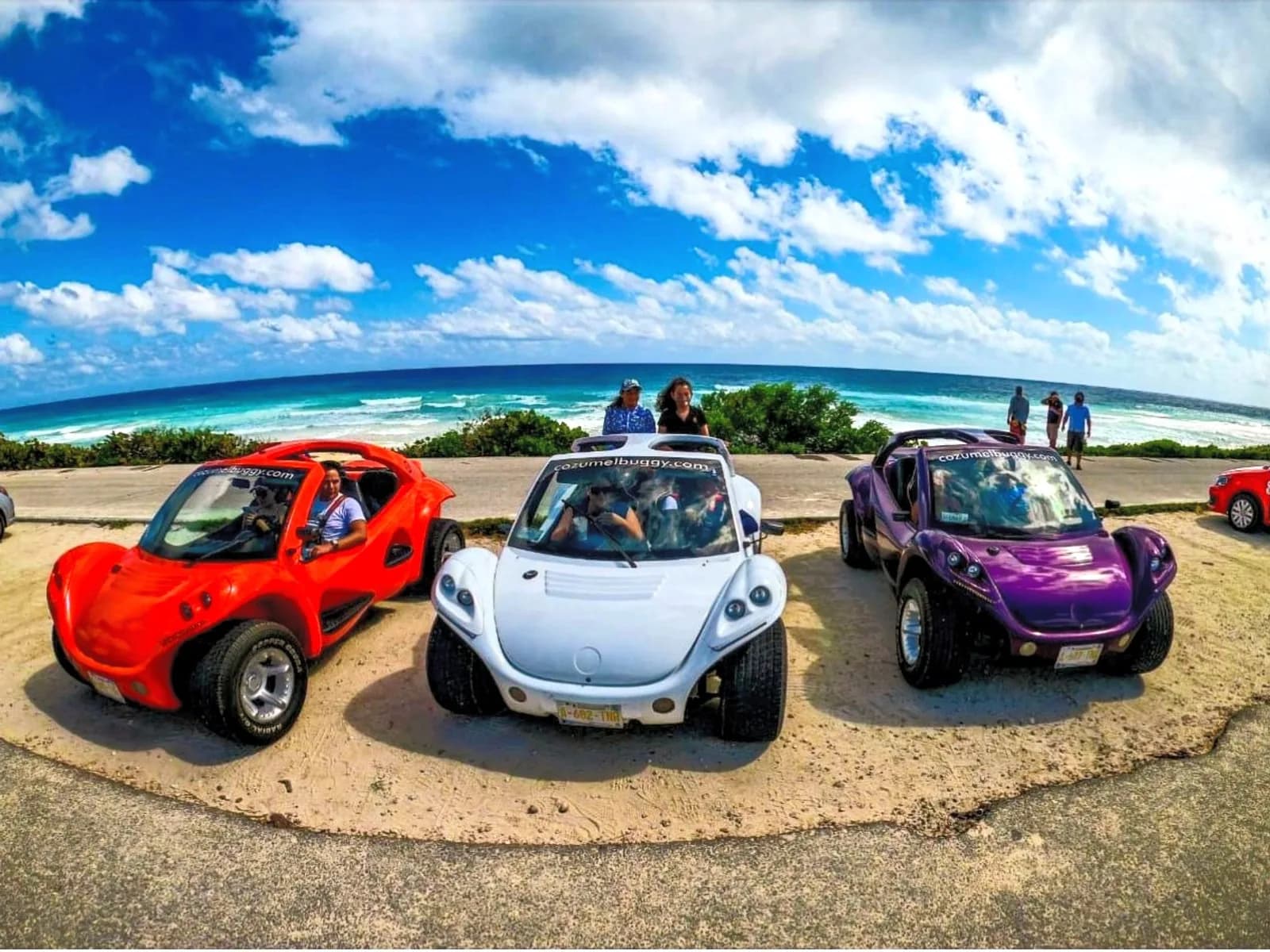
El Cedral, El Caracol and Punta Sur make a natural half-day with beach time built in. Our private Jeep tour is built for it: you drive your own Jeep with a private guide, up to four people per vehicle, Punta Sur Park admission and the wild east side are included, and the itinerary is fully customizable, so asking to stop at El Cedral on the way south is a simple request. The ATV tour takes a different route through the jungle to ruins and an ancient cave that are not reachable by car, then on to hidden east-coast beaches, with pickup from the piers in an air-conditioned van. The Harley-Davidson tour also includes Punta Sur and Mayan ruins on its four-hour private route.
Option three: everything
On a call of eight hours or more, a private guided day can string San Gervasio, El Cedral and Punta Sur together, but the tradeoff is real: you will spend more time in the vehicle than at any single site. Most guests are happier choosing one direction and doing it well.
Whichever you choose, start with the ship's actual hours. The Cozumel cruise schedule shows arrival and departure times by ship and date, and all-aboard is typically half an hour before departure. Work backwards from that: subtract the drive back to your pier, add a buffer for a slow lunch or a lingering photo, and what remains is your real window. Every tour we run carries a Back to Cruise & Ferry Guarantee, so if timing is the thing keeping you at the pier, a guided route removes that worry.
Which Cozumel Mayan ruins fit your group
Different travellers want different things from a ruin, and the island happens to offer three flavours.
History-first travellers
should go to San Gervasio and hire the optional on-site guide. The sacbeob, the oracle shrine of Chichán Nah and the story of the Ixchel pilgrimage are far richer with someone explaining them. Add El Cedral on another visit.
Adventure-first travellers
get more from the southern loop or the ATV route. The ruins become chapters in a bigger day: jungle trails, an ancient cave, empty east-coast sand and a beach club at the end. You will not spend an hour reading placards, but you will understand why the Maya used this island the way they did.
Families
do well at San Gervasio, where the paths are flat and the wildlife is half the fun. Spiny-tailed iguanas sun themselves on the walls, coatis forage along the trails, and the jungle is full of birds. Pair it with a beach afternoon and nobody goes home bored.
Return visitors
who have already seen San Gervasio should make El Cedral and El Caracol the goal. They are small, but they complete the picture, and the drive between them passes some of the least developed coastline in the Mexican Caribbean.
The Mayan ruins Cozumel keeps beyond San Gervasio will never headline a brochure, and that is part of their appeal. They reward the passenger who wants the island's story rather than its postcard. Browse our full range of Cozumel tours to see which routes pass which sites, or start at Cozumel cruise excursions for help matching a ruin, a beach and your ship's schedule into one unhurried day. Family owned and operated since 1996, and if you do not take the tour, we refund your deposit.