

Looking for Cozumel pyramids? Here is what the island's Maya really built, which structures cruise passengers can see, and where the big pyramids are.
Search for Cozumel pyramids and the pictures that come back are usually of Chichén Itzá, a full day's travel away on the mainland. That gap between expectation and reality trips up a lot of cruise passengers, who book a ruins excursion imagining a towering staircase and find a knee-high stone platform in the jungle instead. The honest answer is that Cozumel has no monumental pyramid, and it never did.
What Cozumel does have is more interesting than the search results suggest: a scatter of small Maya shrines, temple platforms, and a lighthouse-like tower, built by a trading and pilgrimage culture that had no reason to stack stone into the sky. Our complete guide to Cozumel Mayan ruins covers the logistics of every site. This article explains what you will actually be looking at, why it looks that way, and how to see it on a port day.
Are There Pyramids in Cozumel?
Not in the sense most people mean. The largest restored structure you can visit, Ka'na Nah at San Gervasio, is a stepped stone platform a few tiers high with the remains of a small temple on top. It is pyramid-shaped in the way a wedding cake is pyramid-shaped. You can walk around it in a minute, and nobody is climbing it.
Everything else is smaller. The San Gervasio complex is a set of six groups of low buildings connected by raised white roads called sacbeob, with an arch marking the entrance to the ceremonial center. Punta Sur has a single squat tower, and El Cedral is one small temple in the middle of a village.
There are many other recorded sites on the island, and the great majority are unrestored mounds that only an archaeologist would notice.
That is not a disappointment once you know what you are seeing. The Cozumel pyramids that searchers imagine belong to a different time and a different kind of city. The island's ruins tell a story about trade routes, pilgrimage, and a goddess, and they do it in a jungle where iguanas sun themselves on the temple walls and motmots call from the trees. Set expectations correctly and the visit is one of the best cultural stops in the western Caribbean.
Why Did the Cozumel Maya Build Shrines Instead of Pyramids?
Three things explain the island's architecture: when it was built, what it was for, and where it stands.
Timing. Cozumel's heyday was the Post-Classic period, roughly 900 to 1500 CE. The famous pyramid cities of the interior, with their massive Classic-period ceremonial centers, had already declined by the time the island's population peaked. The Post-Classic Maya of the Caribbean coast were merchants first, moving salt, honey, cotton, obsidian, and cacao by canoe around the Yucatán Peninsula, and Cozumel sat on that route.
Purpose. The island was sacred to Ix Chel, the Maya goddess associated with fertility, medicine, and the moon. San Gervasio was her sanctuary, and the innermost shrine, Chichán Nah, is believed to have housed an oracle. Colonial-era accounts describe pilgrims crossing from the mainland to consult it. A pilgrimage shrine and a trading port needed many small ceremonial buildings, altars, and way-stations rather than one enormous temple, and that is what the Maya built.
Place and style. Cozumel is a flat limestone island with thin soil and a direct line to every hurricane that enters the western Caribbean. The buildings here belong to what archaeologists call the East Coast style, shared with Tulum, Xcaret, and the ruins at Cancún: thick walls that lean slightly outward, flat roofs, small rooms, and interiors that were once plastered and painted. The red handprints still visible at the San Gervasio structure called Las Manitas are a rare surviving trace of that paint.
The story ends abruptly. Spanish expeditions reached Cozumel in 1518 and 1519, the second under Hernán Cortés, and within decades disease had emptied the island. The shrines were abandoned to the jungle, and the largest of them acquired its modern name only in the nineteenth century, from a landowner called Gervasio Novelo whose ranch enclosed the ruins.
Which Cozumel Structures Look Most Like a Pyramid?
If a pyramid photo is the goal, these are the candidates, ranked from most to least convincing.
Ka'na Nah, San Gervasio
The "Tall House" is the tallest structure at San Gervasio and the one that appears in most photographs of the site. Shoot it from ground level with the trees behind it and it reads as a pyramid.
The Arch, San Gervasio
Not a pyramid at all, but the most photogenic single structure on the island. It marks where the sacbé enters the ceremonial center.
Chichán Nah, San Gervasio
The "Little House" was the oracle shrine, the destination of the pilgrimage. Small and modest, but the most important building on Cozumel.
El Caracol, Punta Sur
A squat tower inside the eco park at the island's southern tip, dating to around 1200 CE. Local tradition holds that conch shells set into the walls whistled when hurricane winds rose, and it is usually described as a Maya lighthouse. The Punta Sur lighthouse next to it, a modern one, offers the view.
El Cedral
The oldest structure on the island, a single small temple in the village of the same name, on the way to the southern beaches.
Castillo Real
A larger ruin on the remote northeast coast, reachable only by rough track. Cruise passengers almost never see it, and no standard excursion includes it.
How Do You See the Cozumel Pyramids on a Cruise Day?
San Gervasio is the anchor for any ruins day. From the piers it is a taxi ride of about twenty minutes and roughly eleven kilometers across the island on the cross-island road. The site is open from 8 a.m. to 5 p.m., and most visitors spend one to two hours walking the groups, which puts the round trip at two and a half to three and a half hours including travel. Bring cash in pesos or dollars for the access road toll, the entrance fee, and an optional guide, because cards are not reliably accepted.
Arrive before 10 a.m. to walk the paths before the heat and the tour groups. Wear closed shoes rather than flip-flops, because the paths between groups are uneven limestone, and carry water; there is shade under the trees but very little at the structures themselves. A licensed guide at the entrance turns the low walls into a story, and for a first visit that is money well spent.
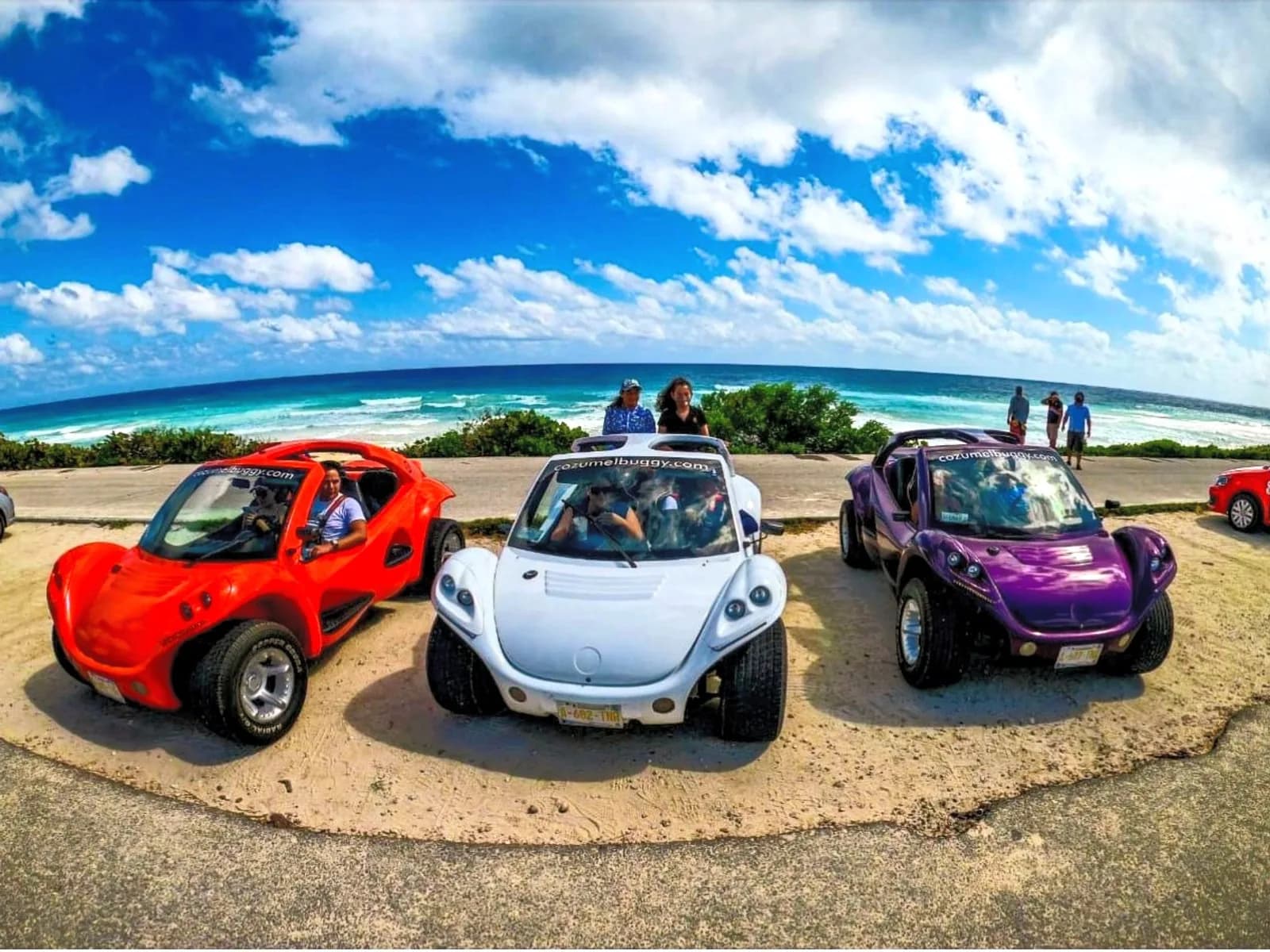
If one ruin is not enough, the southern sites combine naturally with a beach or snorkel stop. Our private Jeep tour includes the Punta Sur park entrance, so El Caracol is part of the day, along with the wild east coast, and the itinerary is fully customizable if you want to add El Cedral. The ATV tour visits Maya ruins and an ancient cave on the way to hidden east-coast beaches, and the private Harley tour combines Punta Sur, ruins, and snorkeling in four hours. Every option on our Cozumel tours page is built around a cruise schedule, with our Back to Cruise & Ferry Guarantee and the NO TOUR, NO FEE deposit policy, so the ruins never put your all-aboard time at risk.
One planning tip: the number of ships in port changes the crowd at San Gervasio more than the season does. Check the Cozumel cruise schedule for your date; on a day with four or five ships, go to the ruins first and the beach second.
Where Are the Real Pyramids Near Cozumel?
The monumental pyramids that dominate image searches are all on the mainland, and each has a different answer for cruise passengers.
Tulum
The clifftop El Castillo above the Caribbean is the closest large Maya structure to Cozumel. Strictly speaking it is a temple on a cliff rather than a stepped pyramid, but it is the photo most people want. Reaching it means a 45-minute ferry crossing to Playa del Carmen and about an hour of road each way, which our ruins guide recommends only for port stops of eight hours or longer, and preferably with a guided tour that manages the timing.
Cobá
Nohoch Mul at Cobá is the tallest pyramid in the northern Yucatán, deep in the jungle inland from Tulum. It sits beyond the range of a Cozumel port day, and climbing has been restricted in recent years, so check the current rules and plan it as a pre- or post-cruise land extension rather than a ship day.
Chichén Itzá
The Temple of Kukulcán, El Castillo, is the pyramid everyone pictures. From Cozumel it is a ten-to-twelve-hour round trip at an absolute minimum, which no cruise port stop allows. If you are spending a night or two in Playa del Carmen or Cancún before or after your sailing, it makes an excellent day trip from there.
For a single day in port, the sensible choice is the island's own ruins, seen properly, with a beach or reef afterward. The Cozumel pyramids that exist are small, old, and surrounded by wildlife, and a good guide turns a pile of stones into a place. Book your San Gervasio, Jeep, or ATV day with the family that has run Cozumel cruise excursions since 1996, and spend your port hours seeing what the Maya really built here.